
A covered membrane is not impossible to test. It is harder to test well.
Dry Electronic Leak Detection works best while a compatible membrane is exposed. Once tiles, ballast, pebbles, drainage cells or landscaping sit above it, the project needs a method that can use the wetted build-up as part of the electrical pathway.
Short answer: Vector Mapping ELD wets the test surface, establishes an electrical field across a defined perimeter and uses handheld directional readings to trace current towards a membrane breach. Electromagnetic Scanning applies related wet electronic principles while producing a continuous directional graph across the test route. Both require a compatible membrane, conductive path, wettable overburden and controlled site conditions.
What changes once the membrane is covered?
With an exposed membrane, a technician can scan directly, mark a discontinuity, repair it and retest.
Under overburden, the membrane is separated from the equipment by one or more layers. Those layers may include:
- tiles and grout;
- screed or mortar beds;
- pavers on pedestals;
- pebbles or ballast;
- protection board;
- drainage cells;
- soil and landscaping; or
- insulation and roof build-up.
The investigation now depends on whether water and electrical current can create a usable connection through that build-up to a breach and the conductive plane beneath the membrane.
Thickness, conductivity, drainage and isolation all matter. A method that works on a tiled podium may not work through a different adhesive, drainage mat or membrane system next door.
How Vector Mapping ELD works
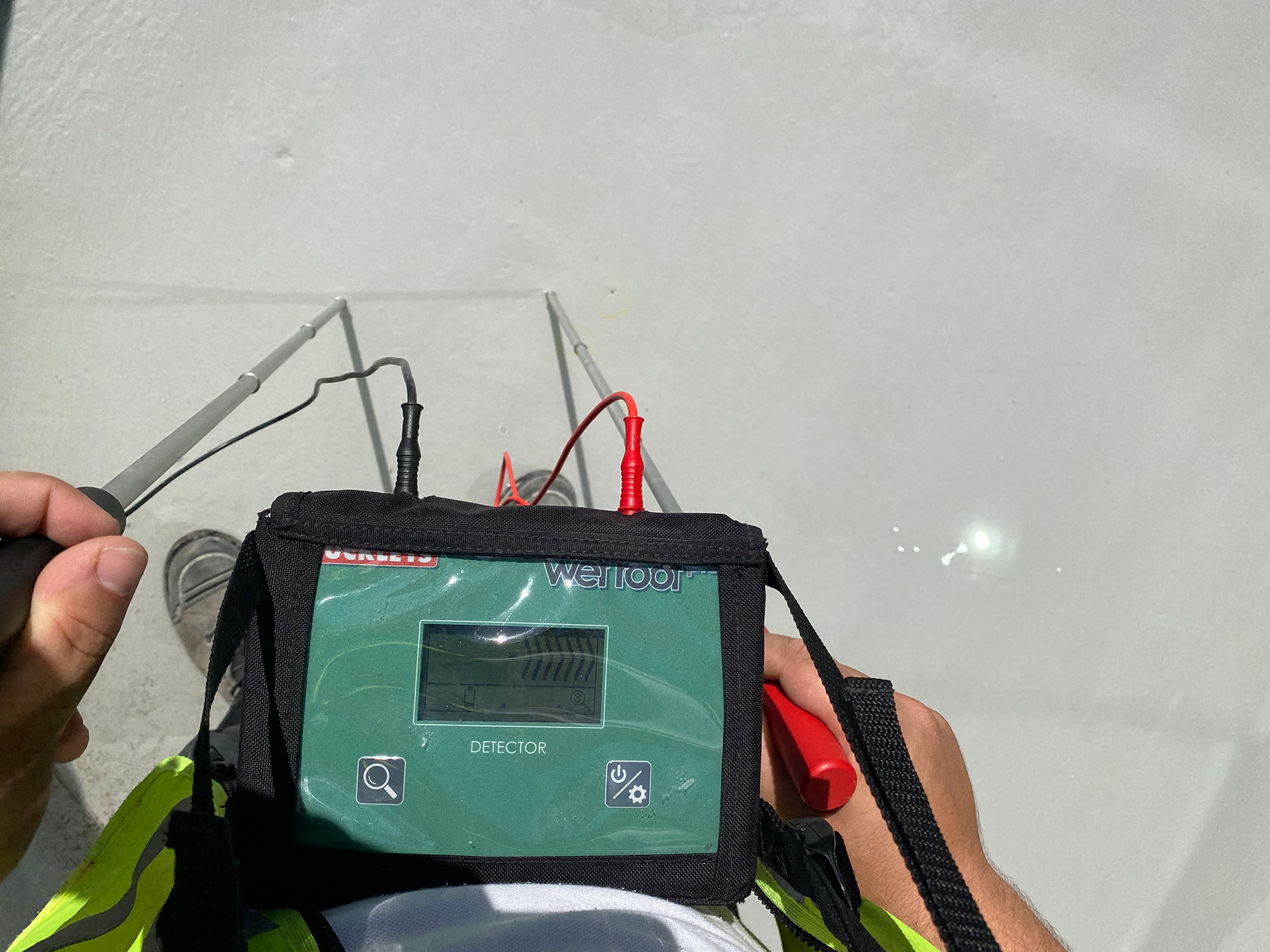
The test area is wetted and bounded with a perimeter conductor. A low-voltage electrical potential is established between the wetted surface and a grounded conductive layer or path beneath the waterproofing membrane.
If the membrane is continuous, current should not pass through it. At a breach, current can flow through the discontinuity.
The technician uses directional probes to read the field across the surface. The readings point towards the current path, allowing the technician to work progressively towards the likely breach location.
It is closer to following a compass than sweeping a detector directly over a hole.
ASTM D7877 provides guidance on electronic methods for detecting and locating leaks in waterproof membranes. The selected procedure, equipment and assembly still need to align with the project.
How Electromagnetic Scanning differs
Electromagnetic Scanning uses a wetted surface and grounded reference to track directional behaviour across the area. The equipment provides continuously graphed information as the operator moves through the test field.
That continuous record can help on larger or more complicated podiums, roofs and landscaped build-ups where a mapped route gives the technician and project team more context.
The practical distinction is not that one method is always better.
- Vector Mapping ELD can suit a defined area where handheld directional readings provide a clear trace.
- Electromagnetic Scanning can suit larger or more complex areas where continuous graphed data improves interpretation and records the path.
Site geometry, overburden, equipment and operator experience should decide the method.
What the assembly needs
Wet electronic testing usually needs:
- a non-conductive waterproofing membrane;
- a grounded conductive plane or path beneath it;
- a wettable, sufficiently conductive surface or overburden above;
- access to establish and control the test perimeter;
- enough saturation to create a continuous test field;
- isolation from drains, metalwork and adjacent zones that could distort current; and
- safe access for the technician to move across the area.
Drawings rarely show every built layer accurately. Product data, photographs during construction and small verification openings may be needed before the method is confirmed.
Where the methods can help
| Covered area | Potential value | Main suitability questions |
|---|---|---|
| Tiled podium | Locate a membrane breach beneath tile and screed build-up | Can the area be wetted and electrically isolated? |
| Ballasted roof | Trace a breach without removing all ballast | Is the membrane non-conductive and is a grounded plane available? |
| Pebbled terrace | Narrow the removal area | Will the wetted surface create a continuous field? |
| Landscaped planter or podium | Target investigation beneath drainage and soil layers | Are build-up depth, drainage and connected zones manageable? |
| Protected membrane roof | Investigate below protection and insulation layers | Does the system permit a reliable current path? |
These are suitability questions, not promises. Some assemblies need trial testing before a wider survey is commissioned.
Conditions that can distort the result
Electrical current takes every available path, not only the one the project wants to investigate.
Distortion can come from:
- drains and metal penetrations;
- conductive toppings or membranes;
- reinforcement exposed to the test field;
- saturated adjacent areas outside the boundary;
- breaks in the wetted surface;
- thick or poorly conductive overburden;
- multiple breaches;
- complex upstands and vertical transitions;
- disconnected conductive planes; and
- services or metalwork within the build-up.
The technician may need to isolate zones, reposition the perimeter, change saturation or compare repeated passes.
A positive response should be marked and documented, then corroborated before broad demolition is authorised.
What the result proves
A located response indicates a likely electrical path through the membrane system under the test conditions.
It does not automatically prove:
- that the identified breach caused the observed internal leak;
- that no other breaches exist outside the tested field;
- that drainage, falls, adhesion and detailing are satisfactory;
- that the membrane will perform indefinitely; or
- that every layer above and below the membrane is sound.
Compare the location with moisture mapping, leak history, drawings, drains, cracks and the presentation point below.
The strongest remedial scope is built from converging evidence.
How results support a remedial scope
The value is not only finding a point. It is reducing uncertainty around removal.
A useful report should give the remedial team:
- test boundary and overburden description;
- membrane and conductive-plane assumptions;
- saturation and isolation conditions;
- equipment and procedure;
- mapped scan routes or directional observations;
- marked likely breach locations;
- anomalous or excluded zones;
- limitations and alternative current paths;
- recommended verification opening; and
- repair and retest requirements.
That lets the contractor price a targeted opening with clear contingencies instead of a full-area strip based on guesswork.
When another method is better
Use another pathway when the assembly cannot support a reliable electrical field or the project question is not membrane continuity.
Options include:
- dry ELD while the membrane is exposed;
- controlled flood testing for a containment question;
- tracer gas for a connected pathway from a known presentation point;
- thermal imaging and moisture mapping for broad screening;
- facade spray testing for windows, joints and cladding interfaces;
- vacuum bell or seam testing for suitable exposed sheet systems; and
- targeted opening-up where physical confirmation is required.
The method should follow the failure mode, not the equipment list.
The cheap testing window has already closed
Vector Mapping ELD and Electromagnetic Scanning are valuable because access is already difficult. They are not a reason to delay integrity testing during construction.
The 2023 NSW survey reported average accumulated serious-defect costs of $283,000 for affected buildings able to provide cost data. It was an all-defects figure. The commercial lesson still applies: once finishes cover the membrane, access and uncertainty become part of the bill.
Use dry membrane integrity testing before covering wherever the assembly permits. Reserve wet electronic methods for the concealed condition they are designed to investigate.
Frequently asked questions
What is Vector Mapping ELD?
It is a wet electronic method that uses a perimeter conductor and directional readings to trace current towards a discontinuity in a compatible waterproofing membrane beneath suitable overburden.
Can Vector Mapping find leaks under tiles?
It can work through some tiled and screeded build-ups if the membrane, conductive plane, wetting, isolation and overburden conditions create a reliable electrical field.
Is Electromagnetic Scanning the same as dry ELD?
No. Dry ELD scans an exposed membrane directly. Electromagnetic Scanning is used on suitable wetted covered assemblies and provides continuously graphed directional information.
Does the test require the area to be wet?
Yes, these wet electronic methods need a continuous wetted path across the test area. Saturation and isolation form part of the test setup.
Is Vector Mapping NATA-accredited at WI?
Vector Mapping ELD and Electromagnetic Scanning are not automatically covered by WI’s current NATA scope. Confirm the exact method and reporting status before booking.
Sources
- ASTM D7877, Electronic Methods for Detecting and Locating Leaks in Waterproof Membranes
- Waterproofing Integrity, Testing services
- Building Commission NSW, 2023 Strata Defects Survey Report
✉️ advice@waterproofingintegrity.com.au
🌐 waterproofingintegrity.com.au
📍 Our offices across Australia: Sydney | Newcastle | Melbourne | Brisbane

Comments (0)