
The ceiling stain is evidence of water. It is not a map to the breach.
Water can travel along slabs, reinforcement, joints, facade cavities, membrane laps, conduits and framing before it becomes visible. Opening directly above the wet patch can miss the source and create a second repair area.
Short answer: Non-destructive leak detection uses thermal imaging, moisture mapping, Electronic Leak Detection, electromagnetic methods, tracer gas and controlled water tests to narrow the likely entry path before demolition. It reduces guesswork; it does not promise zero opening-up. The goal is to make any destructive investigation targeted and evidential.
Can you find a leak without demolition?
Often, you can narrow the likely source or pathway without opening the whole assembly.
Whether the breach can be located non-destructively depends on:
- where water appears and when;
- whether the leak is rain-related, intermittent or continuous;
- membrane and substrate type;
- facade, roof, podium or wet-area build-up;
- access above, below and around the affected zone;
- conductive paths for electrical testing;
- whether the area can be wetted, isolated or pressurised safely; and
- how many previous repairs have changed the assembly.
The investigation may finish with a precise test location. It may instead reduce a 200-square-metre search to one detail that needs opening.
Both are successful outcomes if the evidence is documented.
Why visible water is often not the source
Gravity matters, but so do capillary action, pressure, wind and construction geometry.
Water entering at a facade joint can run along a horizontal frame before dropping at an internal corner. A podium breach can follow a slab crack and appear near a penetration. A roof leak can travel beneath insulation before finding a ceiling joint.
Start by building a timeline:
- first observed date;
- rain direction, duration and intensity;
- delay between weather and visible water;
- whether the leak stops in dry weather;
- affected rooms and levels;
- changes after prior repairs;
- plumbing, irrigation or plant operation; and
- photographs of each event.
Pattern is evidence. A leak that appears only in wind-driven rain asks a different question from one that grows during dry weather.

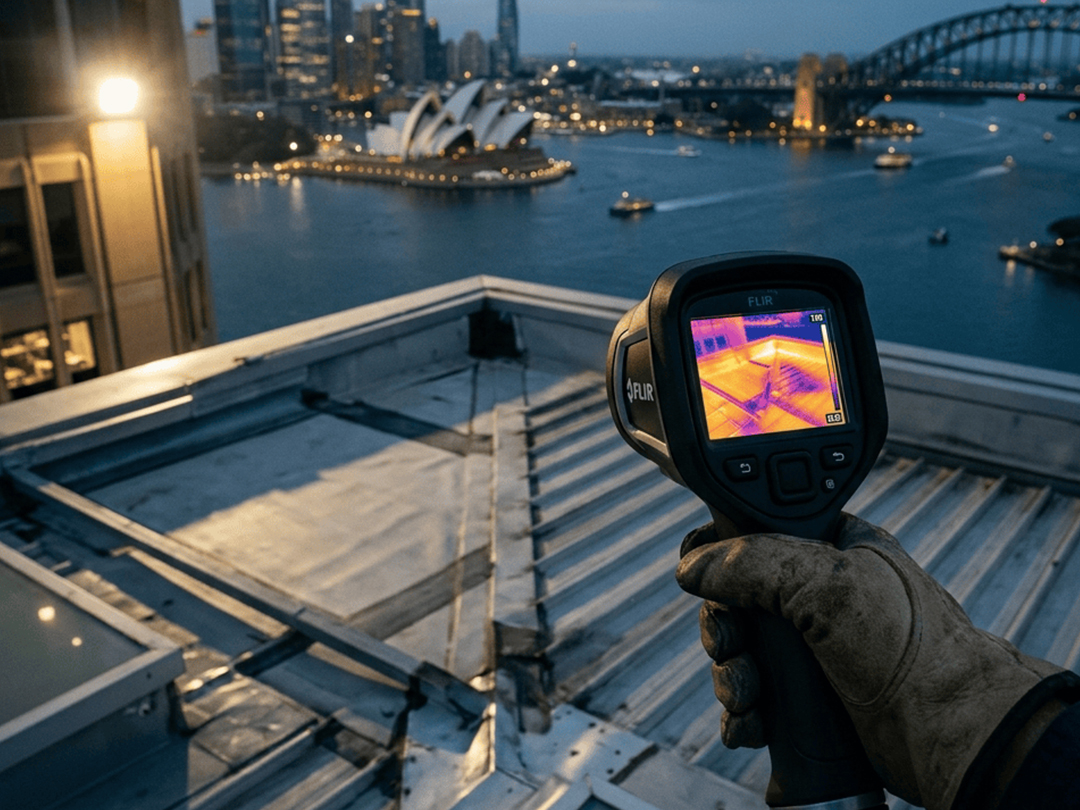
Thermal imaging is a screening method
Thermal cameras record surface temperature differences. They do not see water through walls.
Moisture can create a thermal anomaly because evaporation, heat capacity and conductivity affect surface temperature. The same anomaly can also be caused by insulation gaps, air leakage, shading, structure or recent heating and cooling.
Thermal imaging works best when:
- there is useful temperature contrast;
- the operator understands the assembly;
- interior and exterior conditions are recorded;
- reflective and low-emissivity surfaces are considered;
- the pattern is compared with reference areas; and
- findings are checked with a moisture meter or another method.
ASTM C1153 provides a recognised practice for locating wet insulation in roofing systems using infrared imaging. Its application, conditions and limitations need to match the roof build-up.
A thermal image is a map of temperature, not a photograph of moisture.
Moisture mapping turns isolated readings into a pattern
Handheld moisture meters can compare readings across walls, ceilings, screeds, concrete and finishes, subject to the device and material.
One reading is weak evidence. A grid of readings tied to a marked plan can show the direction, boundary and intensity of an anomaly.
The operator needs to account for metal, salts, density, substrate changes and depth. Different materials should not be compared as though the same calibration applies.
Moisture mapping is useful to:
- confirm whether a thermal anomaly is also moisture-related;
- establish a baseline before controlled testing;
- monitor change during a rain or flood test;
- define the extent of affected finishes; and
- select a targeted opening location.
Tracer gas diagnostic testing
Tracer gas can investigate a connected pathway when the presentation point is known but the entry point is not.
The investigation introduces a detectable gas into a controlled void, crack or pathway, then uses a sensitive detector to find where the gas escapes.
This can reverse the usual leak search. Instead of adding water broadly above and waiting for it to appear inside, the technician starts from the internal pathway and looks for a corresponding escape point.
Controls are essential:
- gas product and concentration;
- safety data and ventilation;
- injection pressure and duration;
- sealing of alternative escape routes;
- detector sensitivity and background checks;
- construction voids and connected spaces; and
- documentation of positive and negative locations.
Gas has different pressure, buoyancy and viscosity from water. A detected gas path supports a connected route under the test conditions. It does not prove that water travels identically without corroboration.
Electronic methods for membrane breaches
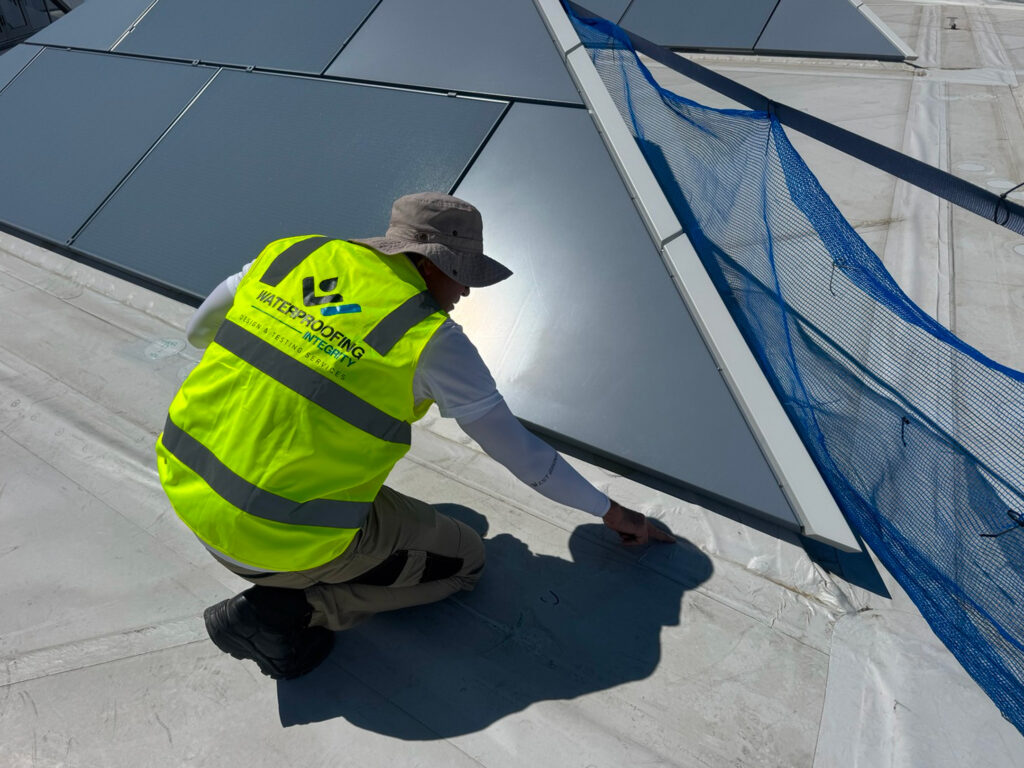
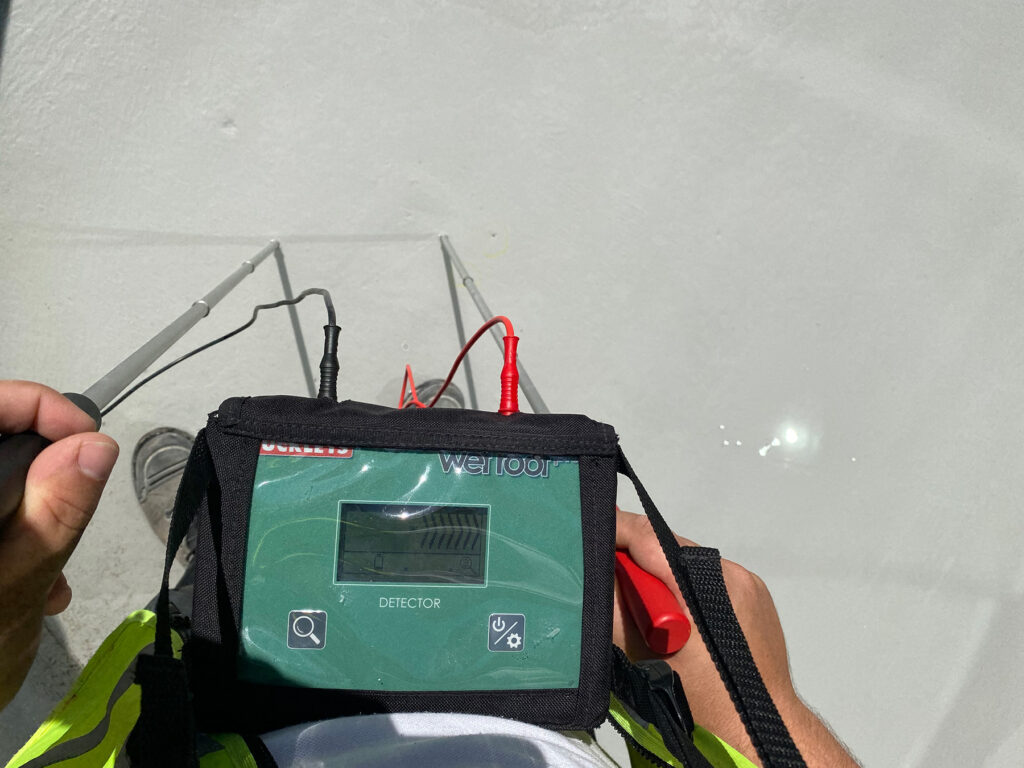
Dry Electronic Leak Detection can locate discontinuities in a suitable exposed non-conductive membrane over a conductive plane or path.
Where the membrane is covered by tiles, ballast or some wettable overburden, Vector Mapping ELD or Electromagnetic Scanning may help trace current towards a breach.
These methods are powerful when the assembly suits them. They are not universal leak detectors.
The membrane, conductive layer, overburden, grounding, saturation and access conditions determine whether the electrical pathway will be reliable.
Electrical testing finds discontinuities. It may not establish which one caused the observed leak without comparing the location to drainage, weather and moisture evidence.
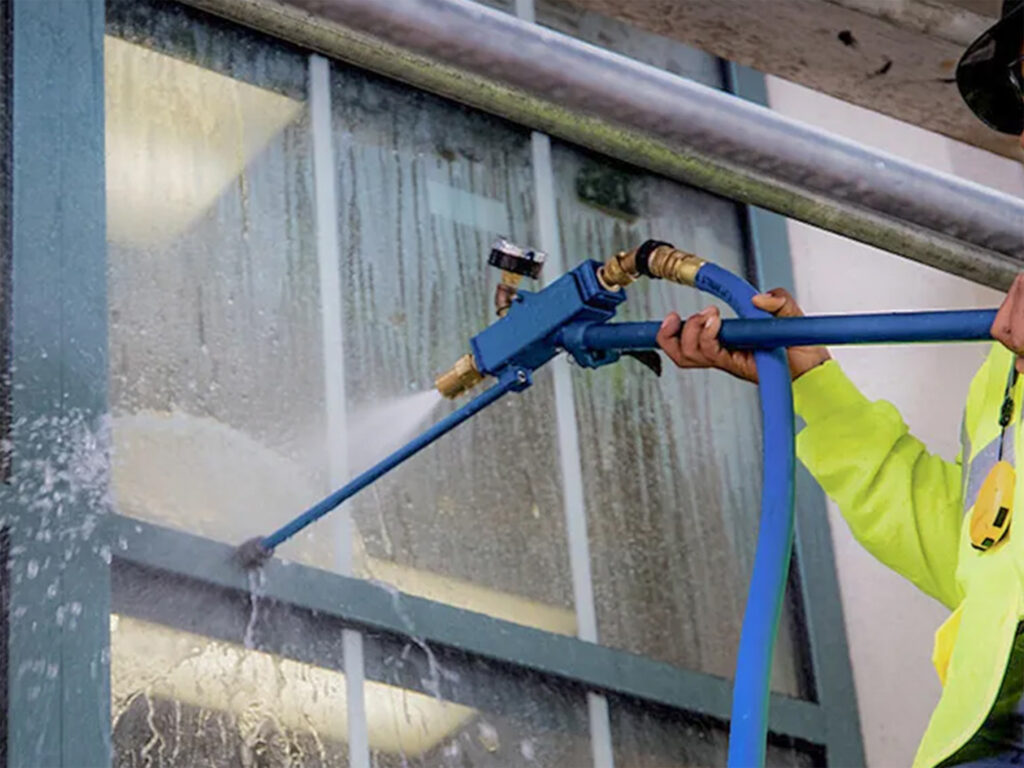
Controlled water testing
Targeted spray, hose, flood or irrigation testing can reproduce the exposure the assembly is meant to resist.
Control one variable at a time. Start low and local, then expand only if the monitored area remains dry. Record flow, pressure, duration, boundaries and observations.
Broad uncontrolled wetting can make the investigation worse. It may activate multiple paths, saturate materials and erase the sequence needed to interpret the result.
Facade spray testing, controlled flood testing and localised water testing each answer different questions. The plan must also protect occupied areas and account for structural water load.
A staged investigation sequence
| Stage | Action | Decision produced |
|---|---|---|
| 1. History | Review drawings, weather, photos and prior repairs | Defines likely exposure and pathways |
| 2. Baseline | Visual inspection, thermal scan and moisture map | Records the pattern before active testing |
| 3. Targeted method | Select ELD, tracer gas, spray, flood or another controlled test | Challenges one pathway at a time |
| 4. Corroboration | Compare results across methods and repeat where needed | Separates a likely cause from an anomaly |
| 5. Opening-up | Open the smallest useful location | Confirms concealed condition and repair scope |
| 6. Close-out | Repair, retest and monitor | Shows whether the identified pathway was resolved |
The order can change, but the logic should not: each step earns the next one.
When destructive investigation is still needed
Opening-up is appropriate when the project needs to see the concealed condition, take a sample, confirm material layers or repair the breach.
It may be unavoidable where:
- the assembly is incompatible with available non-destructive methods;
- multiple hidden pathways produce ambiguous results;
- water has broadly saturated the build-up;
- prior repairs have altered the original detail;
- no access exists for testing; or
- legal or remedial decisions require direct physical evidence.
The difference is timing. Open after the evidence has narrowed the location, not before the investigation has begun.
What to send before booking
Send WI:
- marked location of every visible leak;
- dates, photos and videos;
- drawings, details and waterproofing records;
- weather direction and intensity;
- plumbing, irrigation and plant information;
- previous investigation and repair reports;
- access above, below and adjacent;
- occupied-area constraints; and
- the decision deadline for repair, handover, warranty or dispute.
More history does not slow the investigation. It stops the team repeating failed assumptions.
Demolition is not a diagnostic method
The 2023 NSW Strata Defects Survey found serious waterproofing defects in 42% of the surveyed buildings. That prevalence explains why leak investigations attract pressure. Owners want the water stopped. Builders want a scope. Everyone wants certainty quickly.
Random opening-up feels active, but it can multiply reinstatement without improving the answer.
The better commercial sequence is to screen, test, corroborate, open, repair and retest.
Frequently asked questions
What is non-destructive leak detection?
It is a group of methods used to identify moisture patterns, membrane discontinuities or connected leak pathways without broad demolition. Some methods may still require small local repairs or probe points.
Can thermal imaging find the exact leak?
Thermal imaging can identify surface temperature anomalies that help narrow an investigation. It does not directly see water and should be corroborated.
Is tracer gas safe?
The gas, concentration, injection pressure, ventilation and occupied-space controls need a documented procedure and safety review. The selected product and site conditions determine the controls.
Can ELD find a leak under tiles?
Dry ELD normally needs access to the membrane. Vector Mapping ELD or Electromagnetic Scanning may work through some suitable wettable overburden systems after the assembly is reviewed.
What happens after a likely breach is found?
Document the location and evidence, confirm the concealed condition where required, complete the repair, then retest and monitor the original presentation point.
Sources
- ASTM C1153, Location of Wet Insulation in Roofing Systems Using Infrared Imaging
- Building Commission NSW, 2023 Strata Defects Survey Report
- Waterproofing Integrity, Testing services
✉️ advice@waterproofingintegrity.com.au
🌐 waterproofingintegrity.com.au
📍 Our offices across Australia: Sydney | Newcastle | Melbourne | Brisbane
Comments (0)