
Replacing every sealant joint is not a leak investigation.
Facades combine windows, glazing gaskets, pressure plates, cladding joints, sealants, flashings, membranes, fixings and penetrations. Water can enter through one component, move inside the assembly and appear metres away.
Short answer: Facade water testing applies controlled water to defined joints, interfaces or assemblies while the interior is monitored. AAMA 501.2 is a localised nozzle-spray field check for joints in installed storefronts, curtain walls and sloped glazing systems. It is a diagnostic method, not a whole-facade performance certificate.
How do you test a facade for leaks?
Start with the leak conditions, then choose a test that can reproduce them safely.
A practical investigation sequence is:
- map every internal presentation point;
- review rain direction, wind, duration and delay;
- inspect the exterior and interior details;
- identify likely water-management paths;
- divide the facade into testable zones;
- apply controlled water from low-risk details upwards;
- monitor and document each interval; and
- repair, retest and observe the original presentation point.
The test needs boundaries. If water is sprayed across the whole elevation at once, multiple joints can activate and the result becomes difficult to interpret.
Common facade leak paths
Windows and glazing
Water can pass through failed glazing seals, gaskets, frame corners, pressure-equalisation paths, blocked drainage, end dams or perimeter interfaces.
The frame is designed to manage some water. A visible bead at the perimeter may not be the only line of defence.
Cladding joints and fixings
Open-jointed and drained facade systems rely on cavities, flashings and drainage paths. Face-sealed systems rely more heavily on external continuity.
Cracked panels, displaced joints, fixings and interfaces can create entry points, but the visible defect still needs to be connected to the internal leak.
Sealants
Sealant can fail adhesively at an edge, cohesively through its body or because the joint geometry, movement, backer rod, primer or substrate preparation was unsuitable.
Surface cracking does not always mean the full joint has failed. A neat-looking bead can also be poorly bonded beneath the surface.
Transitions and penetrations
Balcony-to-facade interfaces, slab edges, parapets, awnings, louvres, services and waterproofing terminations often combine multiple trades and materials.
These transitions deserve their own test zones because they rarely behave like the centre of a window or panel.
What AAMA 501.2 testing does
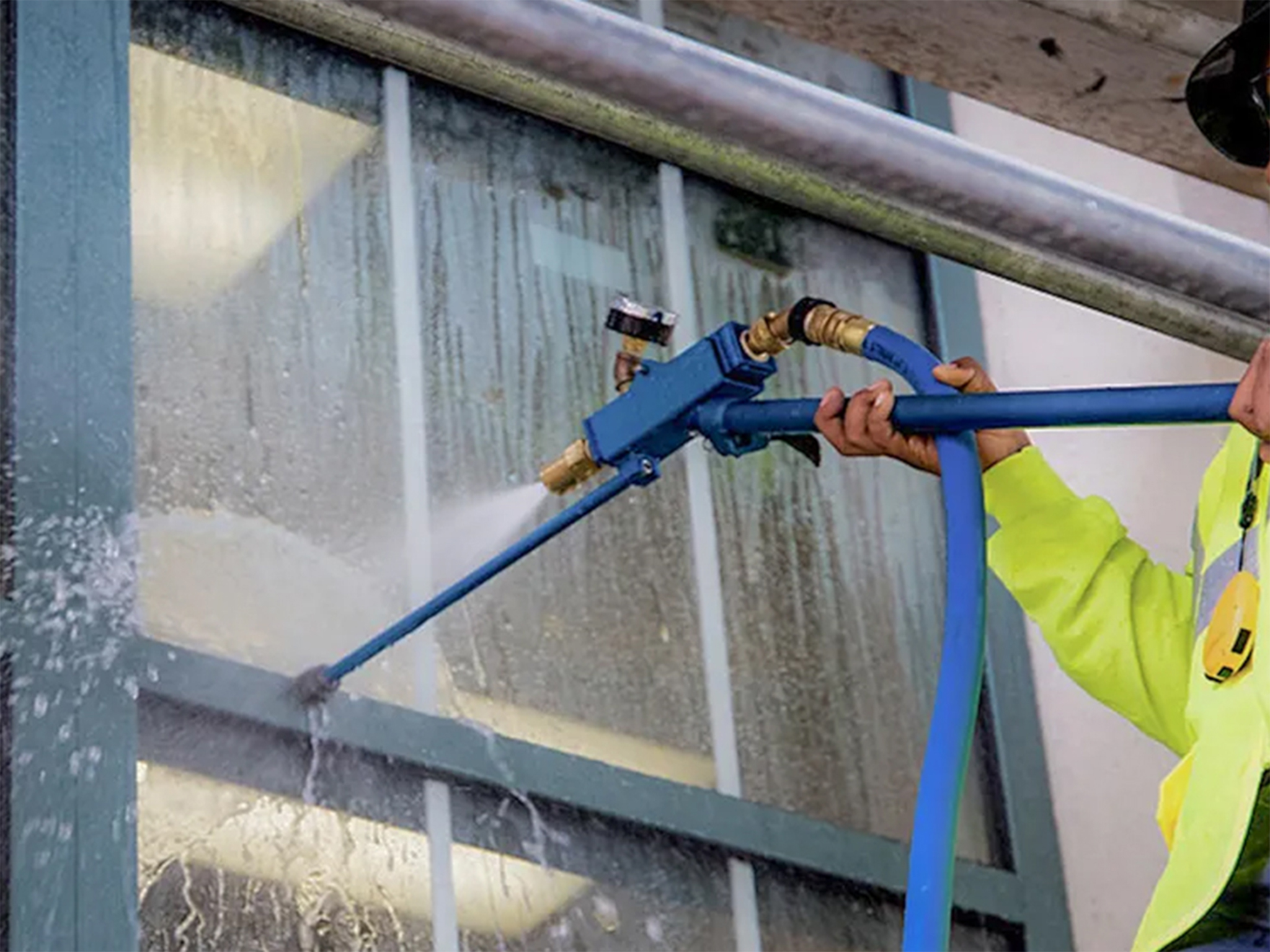
AAMA 501.2 is a localised field check using a calibrated nozzle spray directed at joints in installed storefronts, curtain walls and sloped glazing systems.
The operator works methodically along the selected joint while an observer monitors the interior for water penetration.
Its strengths are speed and localisation. The test can challenge:
- glazing and framing joints;
- frame corners;
- perimeter seals;
- panel and mullion interfaces; and
- repaired details during retesting.
WI’s current NATA scope includes field spray water-penetration checks of door, window and skylight assemblies to AAMA 501.2, subject to the defined scope and a NATA-endorsed reporting arrangement.
The method does not reproduce every combination of wind pressure, rain intensity and building movement. It should not be presented as a pressure-chamber test or whole-wall certification.
When another facade water test is needed
Some questions require water plus a controlled air-pressure difference across the specimen or installed assembly.
ASTM E1105 addresses field determination of water penetration through installed exterior windows, skylights, doors and curtain walls by uniform or cyclic static air pressure difference.
That is a different setup from a local AAMA 501.2 nozzle check.
Other projects may use calibrated spray racks, chamber tests, hose tests or bespoke diagnostic wetting. The specification, facade consultant and failure question should set the method.
Do not swap test names after the fact. If the contract calls for a pressure-differential method, a local nozzle check is not automatically equivalent.
What controlled water testing proves
A positive result connects the applied test water to observed penetration under the documented conditions.
A negative result means no penetration was observed during that test at that zone. It does not prove the entire facade is watertight under every storm.
Interpretation should consider:
- exact water application location;
- pressure, flow, nozzle and duration;
- air-pressure conditions if applicable;
- interior observation points;
- pre-existing moisture;
- test sequence and dwell time;
- wind and weather during the test; and
- whether drainage paths were blocked or altered.
The report should distinguish “no water observed” from a universal pass statement.
Sealant adhesion testing
Where sealant joints are suspected, sampled adhesion testing can check whether the cured sealant remains bonded to the specified substrates.
The result should record:
- joint and substrate identification;
- sealant condition and age;
- primer and preparation information where known;
- sample location;
- adhesion or cohesive failure behaviour; and
- repair of the test cut.
ASTM C794 provides a laboratory peel-adhesion method for elastomeric joint sealants. Field adhesion checks may follow manufacturer or project procedures.
One sampled joint does not represent every joint on the elevation. Use the result to refine a condition map and repair scope.
Thermal imaging and drone survey
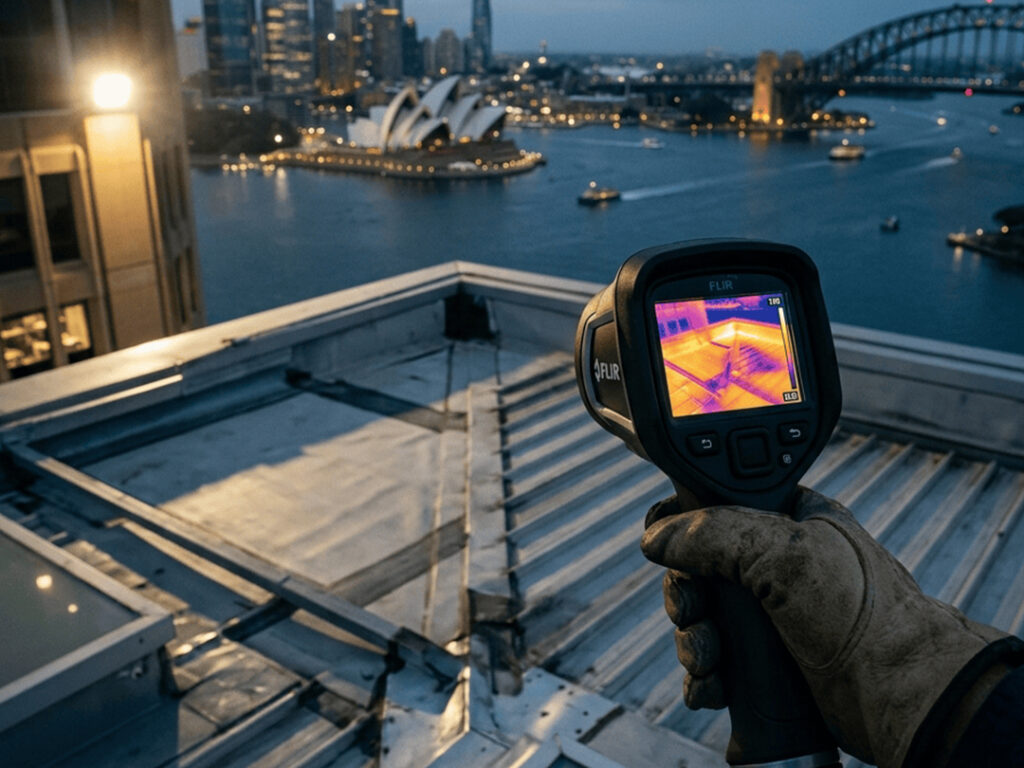
Thermal imaging can identify surface-temperature anomalies associated with wetting, insulation discontinuity, air leakage or structural effects.
It does not see water directly.
On tall or broad facades, drone thermal and optical surveys can screen areas that are difficult to view from ground level. Useful outputs include mapped anomalies, cracked panels, deteriorated sealant, displaced components and zones for closer access.
Drone work needs an approved flight plan, competent operation, weather limits, privacy controls and safe separation from people and structures.
Use thermal and optical data to prioritise hands-on inspection or water testing, not to replace it.
Facade condition assessment
A condition assessment brings the visual, thermal and test evidence into one facade map.
It can record:
- cracks and spalls;
- sealant deterioration;
- displaced cladding or flashings;
- staining and corrosion;
- glazing and gasket defects;
- penetrations and interfaces;
- thermal anomalies; and
- areas that need access, testing or repair.
The map should distinguish observed defects from inferred causes. A crack is an observation. Whether it is the water-entry path is a conclusion that needs testing.
Build the test sequence around the leak
| Leak behaviour | Useful first step | Likely controlled test |
|---|---|---|
| Appears only in wind-driven rain | Review orientation and pressure paths | Local spray followed by pressure-differential testing if required |
| Appears around one window corner | Inspect frame drainage and seals | AAMA 501.2 localised joint check |
| Appears below a balcony edge | Map facade and waterproofing transition | Sequential wetting of interface details |
| Multiple rooms on one elevation | Optical/thermal screening and moisture map | Zone-based spray or rack testing |
| Continues during dry weather | Check plumbing, HVAC and condensation | Do not assume a facade source |
The table helps select the next test. It does not replace drawings or facade expertise.
What a good facade leak report includes
Look for:
- leak history and internal presentation map;
- facade system and test-zone identification;
- drawings and details reviewed;
- test method, equipment and calibration or verification;
- water flow, pressure, duration and sequence;
- environmental and air-pressure conditions;
- photographs before, during and after testing;
- observer locations and time-stamped results;
- positive, negative and inconclusive zones;
- limitations and untested interfaces;
- repair recommendations; and
- retest and close-out requirements.
The report should be specific enough for a facade consultant, contractor, owner or insurer to understand what was challenged.
Public exposure raises the consequence
Facade leaks are not only an internal-finish problem. Persistent water can affect occupied spaces, corrosion, mould, services and the condition of external components.
Replacing components on assumption can also introduce new risk across a much larger area.
Across more than 2,500 projects, WI’s independent position helps keep the investigation tied to the evidence. Test the suspect pathway, document the result, repair the confirmed detail and retest before declaring the issue closed.
Frequently asked questions
What is facade water testing?
It is controlled application of water to defined facade joints, interfaces or assemblies while the interior is monitored for penetration under documented conditions.
What is AAMA 501.2 testing?
It is a localised nozzle-spray field check of joints in installed storefronts, curtain walls and sloped glazing systems. It is not a whole-facade pressure test.
Can facade testing damage the building?
Testing intentionally introduces water, so the plan must protect interiors, services and occupants and control the sequence. The test should stop if unacceptable water entry occurs.
Does thermal imaging prove a facade leak?
No. It maps surface-temperature anomalies. Use moisture checks, visual inspection or controlled water testing to corroborate the finding.
Is AAMA 501.2 testing NATA-accredited at WI?
WI’s current scope includes field spray checks of door, window and skylight assemblies to AAMA 501.2. Confirm the exact assembly, procedure and NATA-endorsed report requirement before booking.
Sources
- NATA, Waterproofing Integrity Design and Testing Services scope
- ASTM E1105, Field Determination of Water Penetration of Installed Exterior Windows, Skylights, Doors and Curtain Walls
- Waterproofing Integrity, Testing services
✉️ advice@waterproofingintegrity.com.au
🌐 waterproofingintegrity.com.au
📍 Our offices across Australia: Sydney | Newcastle | Melbourne | Brisbane
Comments (0)