
The worst time to choose a membrane integrity test is after the membrane has disappeared under the next trade.
Electronic leak detection and flood testing are often treated as interchangeable. They are not. One is designed to locate electrical discontinuities in a suitable membrane. The other checks whether an area contains water under defined test conditions.
Short answer: ELD is usually the stronger option when the project needs to locate breaches in a compatible, exposed non-conductive membrane over a conductive plane or path. Controlled flood testing is useful when the decision is whether a bounded area contains water under the selected depth, duration and site conditions. Neither method suits every assembly, and some projects benefit from both.
Is ELD better than flood testing?
Not as a blanket rule.
Electronic leak detection can pinpoint discontinuities that would otherwise require a broad search. Controlled flood testing can assess the containment behaviour of the tested area, including interfaces that electrical testing may not address in the same way.
The better question is: what does the project need to know?
- Need to locate a breach in a suitable exposed membrane? Consider dry ELD.
- Need to assess whether a bounded area contains water? Consider controlled flood testing.
- Need to investigate a covered membrane? Vector Mapping ELD or Electromagnetic Scanning may be more appropriate, subject to the build-up.
- Need evidence about bond, thickness or seams? Add adhesion, dry-film thickness, vacuum bell or needle-gauge seam testing as relevant.
A membrane can be continuous but poorly bonded. It can be bonded but too thin. It can pass a short containment test and still contain a small discontinuity that did not produce a visible loss during that period.
No single test proves every performance requirement.
How dry electronic leak detection works
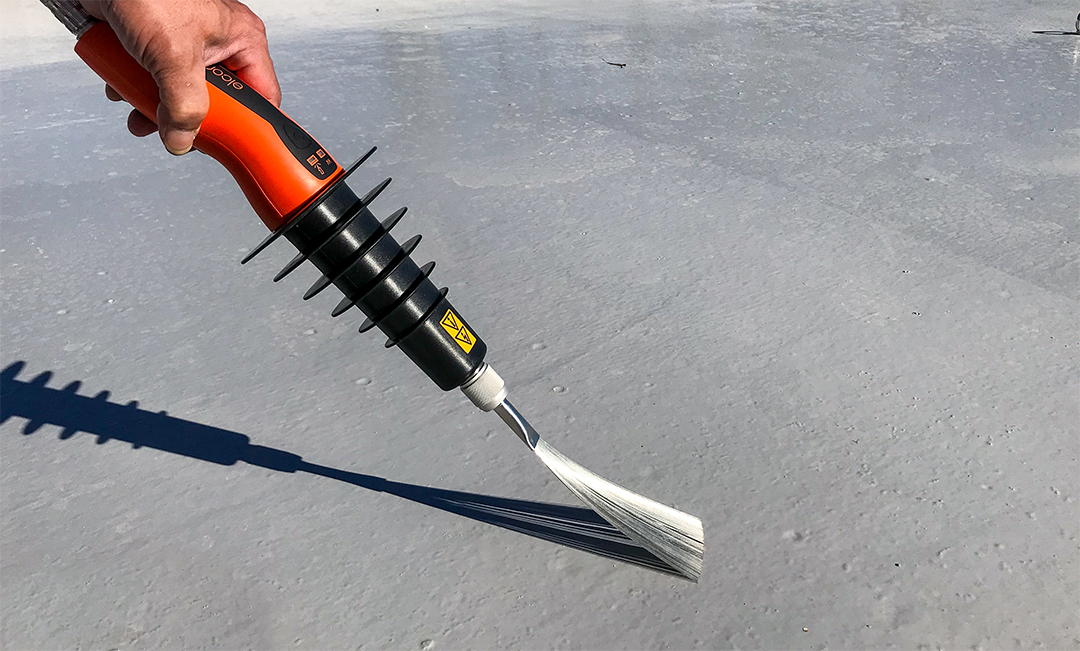
Dry ELD is used on suitable non-conductive membranes where a conductive substrate or grounded path sits below.
The technician passes the test electrode across the membrane. Where the membrane is continuous, the electrical circuit remains open. At a discontinuity, the circuit can complete to the conductive layer beneath, allowing the equipment to signal and the technician to mark the location.
That location-based result is the commercial advantage. A repair team can address a defined point and the area can be retested before it is covered.
AS 3740:2021 recognises electronic leak detection as a method for locating discontinuities in non-conductive waterproofing membrane over a conductive substrate. The project still needs to confirm that the membrane, substrate, thickness, geometry, terminations and site conditions suit the selected equipment and procedure.
Dry ELD is not a generic “leak detector”. It does not track water through the building or identify every possible defect in drainage, falls, bond, detailing or interfaces.
What controlled flood testing proves
Controlled flood testing introduces water to a bounded test area at an agreed depth for an agreed period, then monitors the area and relevant locations below or adjacent for loss or leakage.
Its strength is directness. The project can see whether the tested assembly contains water under those conditions.
ASTM D5957 provides a recognised approach for flood testing horizontal waterproofing installations. A proper test plan should address:
- structural capacity for the water load;
- test boundaries, drains and temporary dams;
- water depth and test duration;
- baseline and final levels;
- evaporation, absorption and weather;
- monitoring locations below and around the area;
- protection of adjacent work; and
- the response to an observed leak or level change.
Flood testing should be controlled, documented and authorised. Filling an area with a hose and returning later is not a defensible test plan.
What flood testing can miss
A passed flood test means the area performed under the test conditions. It does not prove that every part of the membrane is free from discontinuities.
A small breach may sit above the water level, may not produce a measurable loss in the available duration or may drain to a location that is not visible. Evaporation, absorption, drainage behaviour and temporary test details can also cloud interpretation.
Flood testing can also be impractical where the structure cannot accept the load, the area cannot be isolated, water damage would create unacceptable risk or the programme cannot accommodate the preparation and duration.
On the other hand, electrical testing may not address every water-retaining interface. That is why ELD does not automatically replace flood testing.
Where ELD has limits
Electrical testing relies on a compatible assembly and a complete electrical path.
Limitations can include:
- conductive membranes or toppings that prevent the selected method from differentiating a breach;
- no suitable grounded conductive layer beneath the membrane;
- very thick systems, complicated geometry or inaccessible terminations;
- reinforcing, metallic components or wet adjacent materials affecting readings;
- areas already covered by build-ups the selected dry method cannot reach; and
- penetrations and interfaces that require a different test question.
The test boundary matters. So does the equipment setting. A result should identify the tested area, method, conditions, detected locations, exclusions and retest outcome.
When Vector Mapping ELD or Electromagnetic Scanning fits
Once tiles, ballast, pebbles or some landscaped build-ups cover the membrane, direct dry scanning may no longer be possible.
Vector Mapping ELD wets the surface and uses a perimeter conductor with directional readings to trace current towards a breach. Electromagnetic Scanning uses related principles with continuously graphed directional information as the equipment moves across the test area.
These methods can be valuable where the assembly and overburden allow a usable electrical pathway. “Non-destructive” does not mean “works through anything”. Membrane type, build-up depth, conductivity, drainage, saturation, access and grounding conditions all need review.
If the method cannot create or interpret a reliable circuit, targeted opening-up may still be required.
Which test suits each area?
| Area | Likely first pathway | Main reason | Watch-outs |
|---|---|---|---|
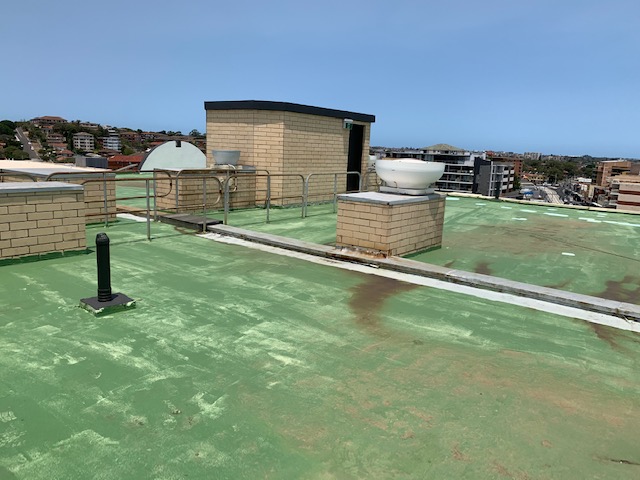
| Exposed roof membrane | Dry ELD, with targeted detail inspection | Locates discontinuities before ballast or finishes | Membrane and conductive-plane compatibility |
| Podium before landscaping | Dry ELD and/or controlled flood testing | Repair access is still open | Drainage, terminations and structural water load |
| Balcony before tiles | ELD or flood testing based on system and boundary | Tests before screed and tiles hide the membrane | Falls, doors, drains and temporary dams |
| Planter box | Controlled flood testing or ELD where suitable | Containment and breach location can both matter | Penetrations, drainage cells and safe water load |
| Tank or water-retaining area | Controlled fill/flood testing under an engineered plan | Direct containment question | Structure, water quality, duration and access |
| Tiled or ballasted leak area | Vector Mapping ELD or Electromagnetic Scanning | Membrane is concealed | Build-up conductivity and saturation |
The table is a starting point, not a test prescription. Drawings and product information can change the recommendation.
When to combine methods
Combining tests makes sense when the project has more than one decision to close.
For example, a podium may need:
- substrate moisture and fall checks before installation;
- detail inspections during installation;
- adhesion or thickness checks for the applied system;
- dry ELD to locate discontinuities before covering;
- controlled flood testing where containment needs to be demonstrated;
- repair and retest records; and
- a final report pack tied to the ITP.
That sequence produces a better handover file than a single pass/fail certificate detached from the construction process.
✉️ advice@waterproofingintegrity.com.au
🌐 waterproofingintegrity.com.au
📍 Our offices across Australia: Sydney | Newcastle | Melbourne | Brisbane

Comments (0)