
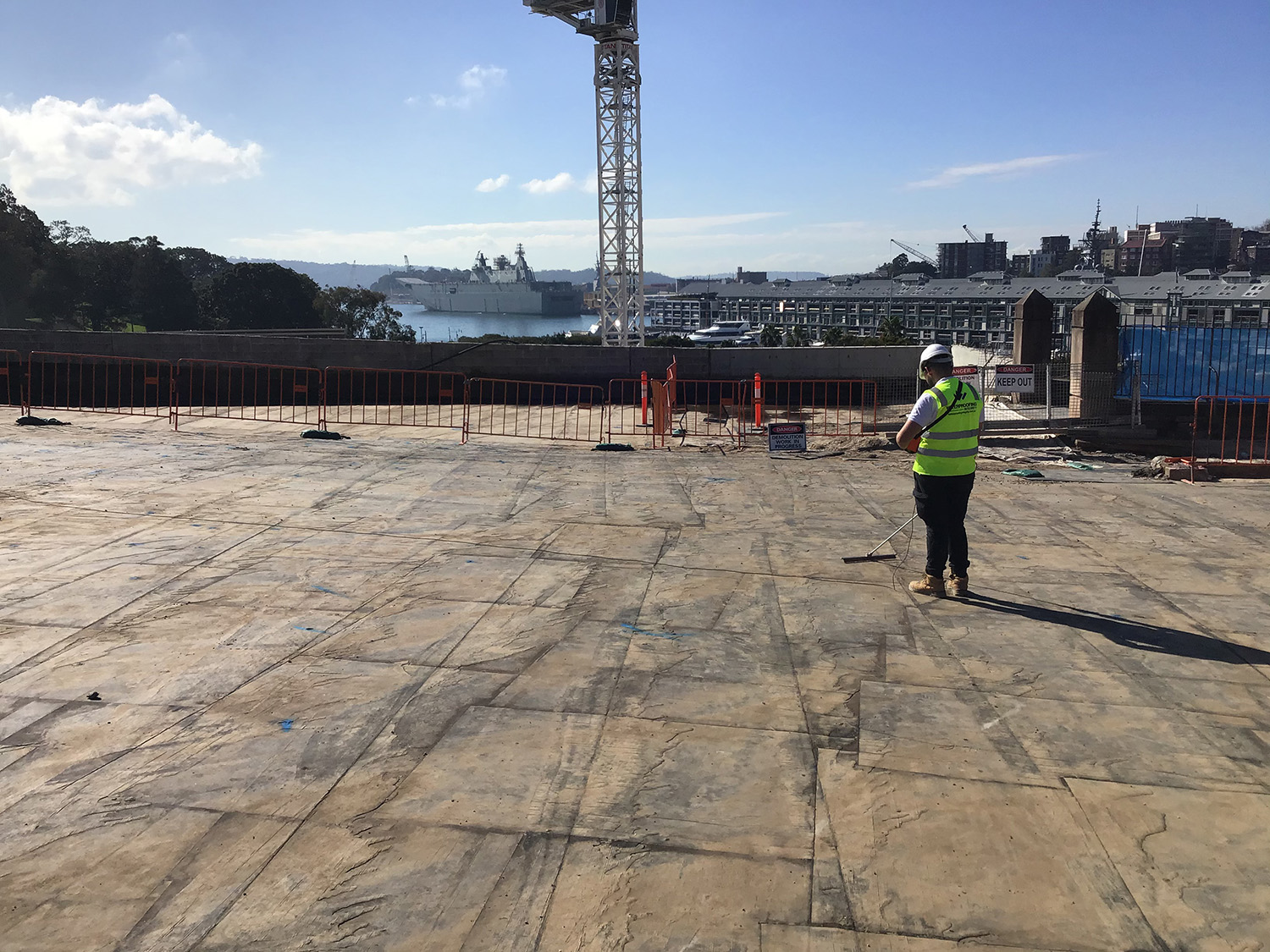
Once the membrane is installed, every substrate problem becomes harder to see and more expensive to prove.
Waterproofing is often inspected as a finished layer. The more useful question comes earlier: was the surface ready to receive it?
Why substrate readiness is a waterproofing risk
A membrane is thin compared with the structure beneath it. It follows the falls, cracks, edges and imperfections it is installed over.
If the substrate is too wet, the system may blister, debond or trap moisture. If the surface is weak or contaminated, the membrane can pull away with the laitance. If the profile is too smooth, bond may suffer. If it is too rough, the installed thickness can become inconsistent. If the falls send water away from the drain, a perfect membrane can still sit under ponding water.
The installer can repair some conditions. The designer or builder may own others. The testing plan should identify the issue before membrane work starts and before responsibility becomes blurred.
Across more than 750 design projects, WI has seen how drainage geometry, interfaces, movement and sequencing set the conditions the installer inherits. Substrate testing connects the drawing to the built surface.
Surface moisture testing is a screening tool
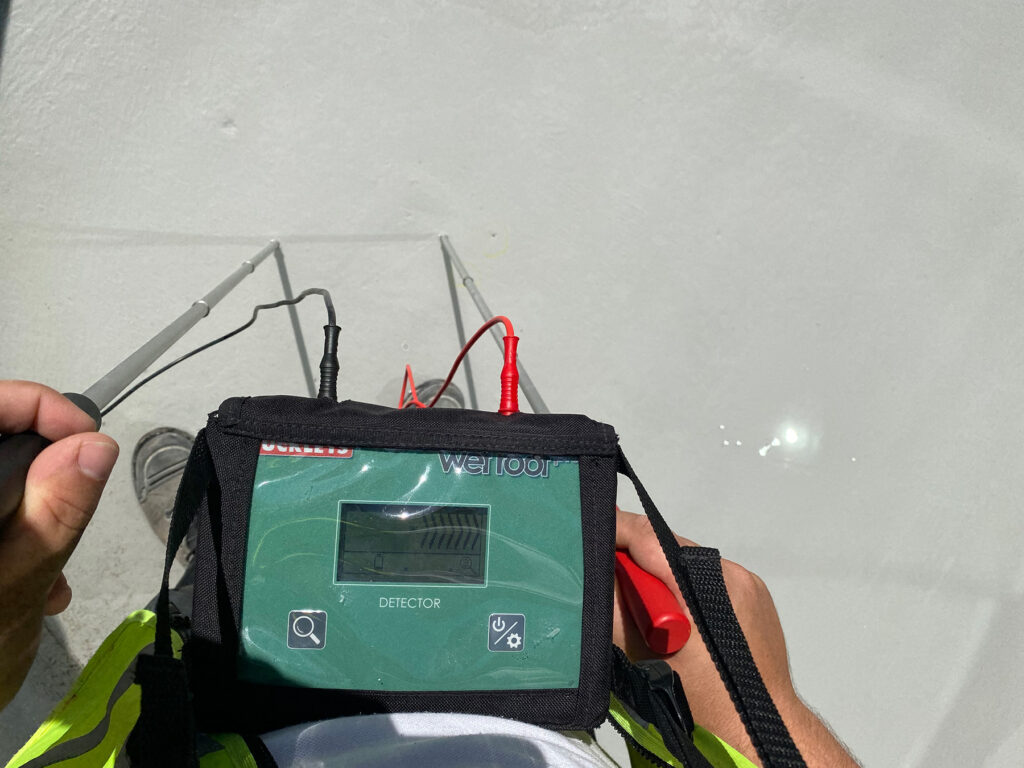
Handheld surface moisture meters are fast and useful. They can compare readings across concrete, screeds or masonry and help identify areas that behave differently.
They are usually indirect instruments. The device infers moisture condition from an electrical property calibrated for a material. Readings can be influenced by:
- material type and density;
- salts and conductive contamination;
- reinforcement or embedded metal;
- surface treatments;
- temperature;
- depth of the moisture; and
- whether the device calibration suits the substrate.
A meter calibrated for concrete should not be assumed to give an equivalent moisture percentage on a different screed.
Use surface moisture testing to screen an area, compare locations and decide where closer investigation is needed. Do not turn an indicative reading into a claim about the full depth of the slab unless the method supports it.
In-situ relative humidity testing and ASTM F2170
In-situ RH testing measures the equilibrium relative humidity inside a drilled hole at a prescribed depth in a concrete slab.
ASTM F2170 sets out the procedure for determining relative humidity in concrete floor slabs using in-situ probes. The hole depth, number of test locations, conditioning period, probe verification and environmental conditions all affect the result.
This is a stronger pathway where the coating, membrane, flooring system, warranty or specification sets an internal RH limit.
It is also one of the activities on WI’s current NATA scope for concrete panels. Confirm that the product, substrate, exact procedure and reporting requirement fit the accredited scope before booking a NATA-endorsed result.
RH is not the same as total moisture content. The report should state what was measured, at what depth, after what equilibration period and against which project criterion.
The manufacturer or authorised design party still needs to set the acceptable threshold for the system.
Moisture tests answer different questions
| Method | What it tells you | Best use | Main limitation |
|---|---|---|---|
| Handheld surface meter | Comparative or indicative near-surface response | Fast screening and moisture mapping | Material, salts, metal and depth affect readings |
| In-situ RH probe | Equilibrium relative humidity at a prescribed depth | System acceptance where ASTM F2170 or an RH limit is specified | Requires drilling, conditioning time and correct location count |
| Gravimetric or laboratory method | Moisture determined from a removed sample under its procedure | Direct sample evidence where specified | Destructive and local to the sample |
| Visual inspection | Visible water, darkening, condensation or curing condition | Immediate site observations | Cannot quantify internal condition |
The methods can work together. Surface screening finds the pattern. In-situ probes give stronger evidence at selected locations.
Surface fall gradient testing
Waterproofing should direct water to the drainage system, not simply stop it entering the structure.
Surface Fall Gradient Testing records levels across balconies, roofs, podiums and wet areas to determine direction and gradient. Laser levels or survey equipment replace “it looks about right” with a mapped result.
The test plan should identify:
- the structural substrate and finished surface being assessed;
- drain points, channels, gutters and overflow routes;
- required gradients and tolerances;
- high points, low points and local backfalls;
- door thresholds, joints and penetrations;
- the effect of screeds, toppings and membrane build-up; and
- who will accept the measured geometry.
NCC 2025 includes revised external waterproofing provisions, including structural-substrate fall requirements in relevant applications. Adoption and transitional arrangements vary, and project-specific Performance Requirements, Deemed-to-Satisfy provisions and referenced standards still need review.
The safest approach is to confirm the applicable requirement during design, then survey the built condition before the membrane hides the substrate.
Concrete surface profile testing
Surface preparation creates texture for the waterproofing system to bond to.
Concrete Surface Profile, often shortened to CSP, can be assessed against recognised profile comparators. The required profile depends on the membrane, coating or repair product.
A surface that is too smooth may not provide enough mechanical key. One that is too rough can create pinholes, excessive material demand and low spots in the applied film.
Profile checks should be combined with observations for:
- laitance and weak surface material;
- curing compounds, sealers, oils and contamination;
- dust after grinding or blasting;
- bugholes, blowholes and honeycombing;
- sharp ridges and protrusions;
- cracks and construction joints; and
- patching compatibility.
The profile number is not a cleanliness certificate. The surface still needs to be sound and prepared in line with the system requirements.
When substrate strength matters
Some waterproofing and remedial systems need evidence that the surface or repair material can carry the required bond.
Schmidt hammer testing can compare rebound response and identify anomalous concrete zones. Pull-off testing can assess adhesion or tensile failure at the tested interface. Cores may be needed when direct compressive-strength evidence is required.
These methods are not interchangeable.
If a pull-off test fails within weak concrete, the membrane adhesive may not be the problem. If the result fails at the coating interface, preparation or compatibility may need review. Record the failure mode, not only the peak number.
A practical pre-installation sequence
- Review drawings, specification, membrane data and warranty conditions.
- Confirm the substrate type, age, curing history and known treatments.
- Survey falls, drains, thresholds, joints and penetrations.
- Inspect for cracks, laitance, contamination, damage and incomplete repairs.
- Screen moisture across the proposed area.
- Install in-situ RH probes where the system or risk requires stronger evidence.
- Verify surface profile and cleanliness after preparation.
- Test strength or adhesion where acceptance depends on it.
- Record non-conformances, repairs and retest results.
- Release the membrane hold point only when the authorised party accepts the evidence.
That sequence can be adapted. The important point is that the release decision is explicit.
The cost comparison is not membrane versus testing
Before installation, the project can dry, grind, patch, regrade, clean or wait.
After installation, the same decision may require destructive openings, membrane removal, expert reports, delay and reinstatement before the substrate is visible again.
The testing cost should be compared with the risk of accepting an unsuitable surface, not with the cost of one roll or drum of membrane.
Frequently asked questions
How do you know concrete is dry enough for waterproofing?
Use the test method and threshold required by the membrane or coating manufacturer, specification and project team. Surface meters can screen; in-situ RH testing provides depth-specific evidence where ASTM F2170 is required.
Is a handheld moisture meter enough?
It may be enough for comparative screening on a low-risk application if the authorised party accepts it. It does not necessarily establish moisture condition through the slab.
What is a concrete surface profile?
It is the texture of prepared concrete, commonly compared with profile chips or another specified method. The required profile depends on the product and application.
Should falls be checked before or after waterproofing?
Check the structural substrate and any formed falls before membrane installation, then verify the finished drainage outcome where required. Testing only at the end can leave the cause buried.
Is ASTM F2170 testing NATA-accredited at WI?
WI’s current NATA scope includes moisture-content testing of concrete panels using ASTM F2170. Confirm the exact project conditions and whether a NATA-endorsed report is required before booking.
✉️ advice@waterproofingintegrity.com.au
🌐 waterproofingintegrity.com.au
📍 Our offices across Australia: Sydney | Newcastle | Melbourne | Brisbane
Comments (0)