
A waterproofed surface can keep the level below dry and still create a problem at the surface.
Balconies, podiums, exposed membranes, rooftop walkways, wet areas and public access routes are walked on in conditions that change. Rain, cleaning, dust, wear, coatings and maintenance all affect how the surface behaves underfoot.
Short answer: Slip resistance testing is needed when a project must classify a pedestrian surface, check it against a specified criterion, investigate a complaint or demonstrate that a trafficable waterproofed finish is suitable for its intended use. The number only becomes useful when the test method, surface condition, location and acceptance criterion are clear.
When do you need slip resistance testing?
The best time is before people start using the area and while the project can still respond to the result.
Common triggers include:
- handover of new pedestrian surfaces;
- application of a trafficable waterproof coating or membrane;
- balconies, terraces, rooftop plant routes and podium walkways exposed to rain;
- pool surrounds, amenities and other areas expected to be wet;
- a change in coating, sealer, cleaning treatment or maintenance regime;
- refurbishment of an existing public-use surface;
- complaints, near misses or a slip incident; and
- due-diligence or asset-condition reviews.
Testing is not only for polished tiles. The waterproofing system may itself be the trafficable finish. If people will walk on it, surface grip belongs in the performance discussion.
Why slip risk matters on waterproofed surfaces
Waterproofing and slip resistance are often specified by different people, then brought together on site.
The membrane or coating team is focused on continuity, adhesion, thickness, drainage and detailing. The architect or asset team is focused on appearance, use and cleaning. The builder is focused on handover. None of those priorities removes the need to prove how the finished surface performs underfoot.
A surface may become more slippery when wet. Texture can be reduced by a clear coat. Aggregate can be distributed unevenly. Ponding can keep a walking line wet. Cleaning products can leave residue. Heavy traffic can polish the highest points over time.
This is why a product data sheet is not the whole answer. A laboratory classification for a sample product does not automatically establish the installed condition at every location.
Independent on-site testing checks the surface the project actually built.
What a wet pendulum test is
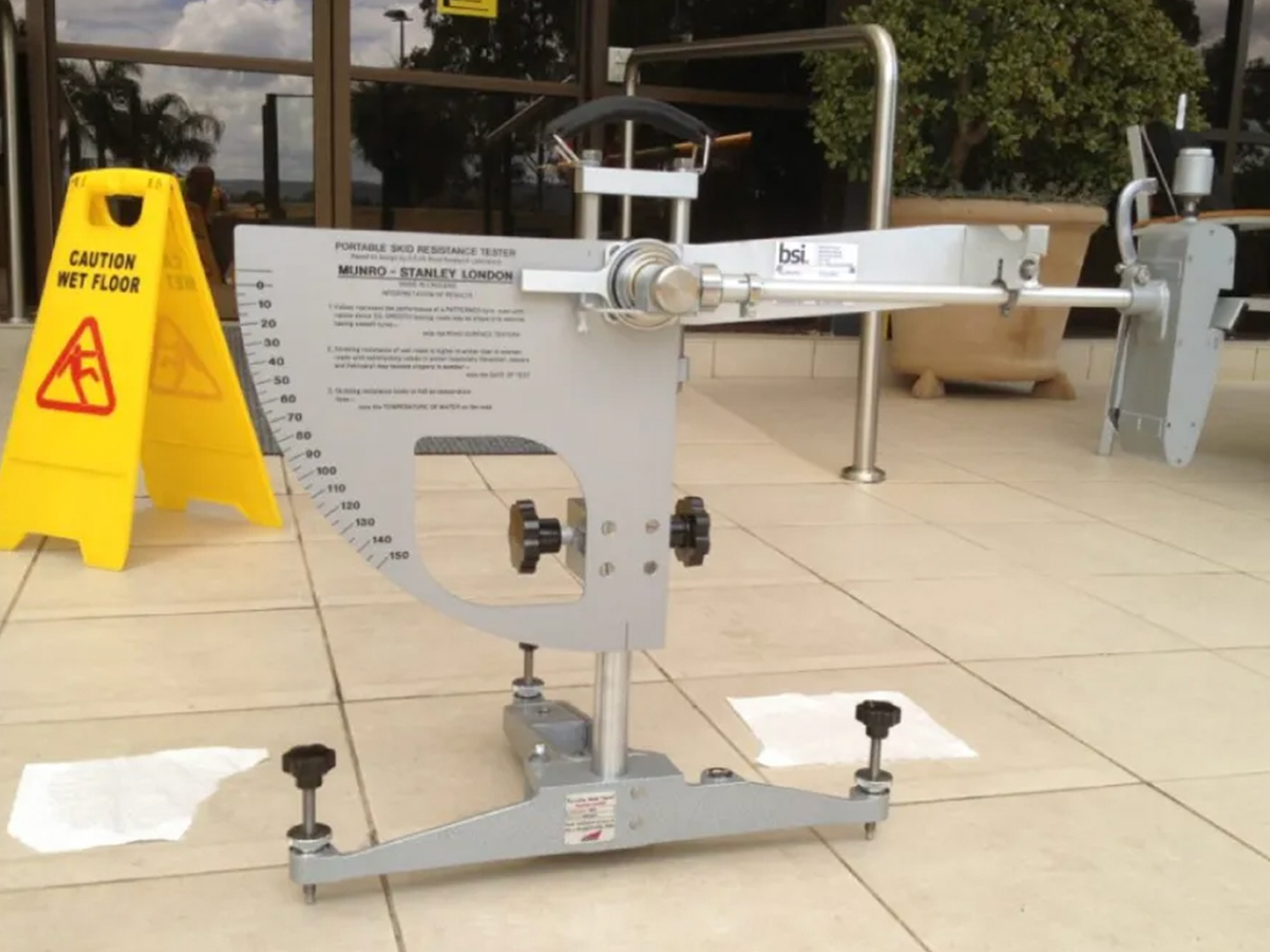
The wet pendulum is a portable device used to assess the frictional characteristics of a pedestrian surface under controlled test conditions.
A conditioned rubber slider travels across the wetted surface. The loss of energy in the pendulum swing is measured and used to determine a slip resistance value and classification under the applicable procedure.
In plain English, the device measures how much the wet surface slows the slider.
The method is established, but the result is sensitive to how the test is performed. The technician needs to control:
- slider type, condition and preparation;
- equipment verification and levelling;
- test direction;
- water and surface condition;
- number and location of test points;
- cleaning or contamination before testing;
- temperature and environmental conditions where relevant; and
- calculation and reporting of the result.
The report should identify the procedure used. AS 4586 is used for classification of new pedestrian surface materials. AS 4663 addresses existing pedestrian surfaces. The project may also use guidance in the relevant handbook or risk assessment to connect a classification to the intended use.
The standard produces a classification. Suitability is a project decision informed by that result.
A pass number without context is weak evidence
Slip resistance is not one universal threshold for every surface.
An external ramp exposed to rain, a private balcony, a rooftop service path and an internal dry corridor do not have the same use, users or consequences. The acceptance criterion should be set by the specification, code requirement, design professional, risk assessment or asset standard relevant to the area.
Before testing, record:
- the intended use of the surface;
- whether it will normally be dry, wet or contaminated;
- slope, drainage and walking direction;
- expected users, including mobility limitations;
- footwear conditions;
- the specified classification or project criterion;
- the applicable test method; and
- who has authority to accept the result.
Without that context, a result can be technically correct and still fail to answer whether the surface is suitable.
Where to test
Sampling should reflect the way the surface was installed and how people will use it.
Useful test locations can include:
- primary walking lines;
- entries, exits and door thresholds;
- changes in slope or direction;
- areas near drains and low points;
- zones exposed to weather;
- transitions between products or batches;
- repaired or recoated areas;
- locations with different aggregate broadcast; and
- any reported incident or complaint area.
Averages can hide local problems. One high-grip zone should not cancel out a weak result on the main path of travel.
Photographs and a marked-up test plan make the report easier to use. They show exactly which installed condition each result represents.
Why independence matters
If the installer, coating supplier or maintenance contractor tests their own work, the result may still be useful. The commercial question is whether everyone who needs to rely on it will accept the evidence.
Independent testing separates the result from the party that selected, sold, installed or cleaned the surface.
That becomes important when:
- a handover item is disputed;
- the result may require rework;
- public access depends on the decision;
- a manufacturer and installer disagree about application;
- an asset owner is comparing competing repair options; or
- the report may later be reviewed by an insurer, lawyer or expert.
WI does not install waterproofing systems or sell trafficable coatings. The testing question stays focused on the surface and the criterion.
Slip testing belongs beside waterproofing QA
On a trafficable waterproofed surface, grip is only one part of the evidence plan.
The same area may also need:
- substrate moisture or relative humidity testing before coating;
- concrete surface profile checks;
- adhesion testing to confirm bond;
- dry-film thickness or ultrasonic thickness testing;
- Electronic Leak Detection or controlled flood testing for membrane integrity;
- surface fall gradient testing around drainage; and
- inspection of joints, penetrations, terminations and transitions.
These tests answer different questions. A good slip result does not prove waterproofing continuity. A passed ELD result does not prove the finish is suitable to walk on.
The handover file should make both outcomes visible.
What a useful slip resistance report includes
A report should allow another person to understand and, if needed, scrutinise the result.
Look for:
- project, area and surface identification;
- date, weather and surface condition;
- test method and equipment;
- slider type and preparation;
- marked test locations and directions;
- individual readings, calculated values and classification;
- photographs of the test points;
- the nominated acceptance criterion, if supplied;
- limitations, exclusions and observed contamination;
- a clear statement of whether each location met the nominated criterion; and
- recommendations for treatment and retesting where requested.
The report should not quietly turn a sampled test into a claim about untested areas.
When to retest
Retesting is sensible after a coating, sealer, cleaning treatment or repair changes the surface.
It can also form part of an asset-management plan where weather, wear, contamination or maintenance may reduce slip resistance over time.
The interval depends on use and consequence. A rarely accessed private area does not carry the same exposure as a wet public walkway. Incident history, cleaning regime and visible surface change should also influence the review point.
Public access changes the consequence
A borderline result at a concealed plant area may be managed differently from the same result on a public route.
Once people are using the surface, the question is no longer only whether the finish matches the specification. It is whether the asset owner understood the risk, selected a suitable criterion, tested representative locations and responded to the evidence.
Across more than 10,000 inspections, WI has seen how small unresolved details become handover arguments and operational risks. Slip resistance testing gives the team a chance to act while the surface can still be treated, documented and retested.
Frequently asked questions
What is slip resistance testing?
It is testing that measures or classifies the frictional performance of a pedestrian surface under a defined method and condition. The wet pendulum is a common on-site method in Australia.
What is the difference between AS 4586 and AS 4663?
AS 4586 addresses classification of new pedestrian surface materials. AS 4663 addresses existing pedestrian surfaces. Confirm the current edition and the method required for the project.
Does a slip classification guarantee nobody will fall?
No. Falls are influenced by surface condition, slope, contaminants, footwear, behaviour, lighting and user capability. Testing is evidence about the sampled surface under stated conditions.
Should exposed waterproof membranes be slip tested?
If the membrane or coating is a trafficable finish or forms part of an access route, slip resistance should be considered against the intended use and project criterion.
Can a failed surface be repaired and retested?
Often, yes, but the treatment must be compatible with the waterproofing system and should not create a new adhesion, drainage, thickness or maintenance problem. Test the treated area again before close-out.
✉️ advice@waterproofingintegrity.com.au
🌐 waterproofingintegrity.com.au
📍 Our offices across Australia: Sydney | Newcastle | Melbourne | Brisbane
Comments (0)