
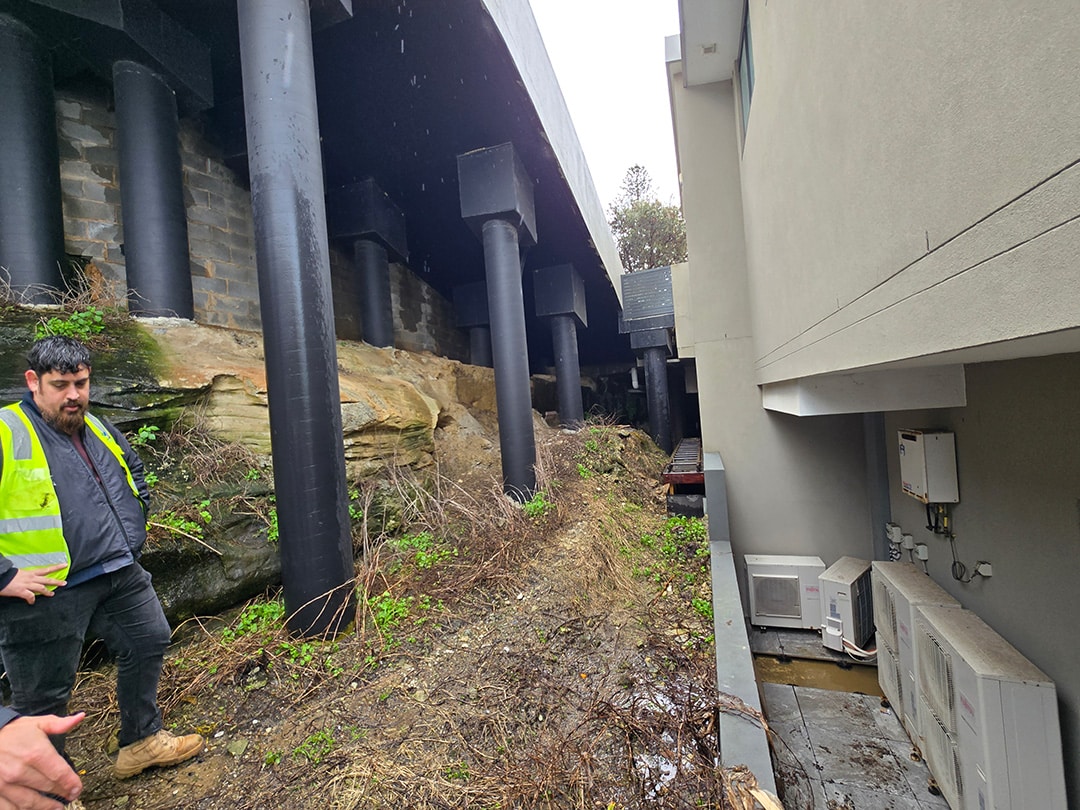
A waterproofing repair can only be as effective as the diagnosis behind it.
For remedial builders, one of the most difficult situations is being asked to fix a waterproofing problem without a clear understanding of the cause.
The symptoms may be obvious. The cause may not be.
The common remedial cycle
A typical reactive approach looks like this:
Leak → Remove finishes → Repair obvious defect → Refinish → Leak returns
The problem is that the repair may have addressed what was visible rather than what caused the water ingress.
Why does waterproofing fail?
Potential causes can include:
• membrane failure
• inadequate detailing
• failed junctions
• movement
• substrate defects
• inadequate falls
• drainage issues
• failed sealants
• penetrations
• construction interfaces
• moisture trapped within the system
• incompatible repair materials
• previous unsuccessful remediation
Several causes can also exist at the same time.
What does a builder need before starting remedial waterproofing?
A useful remedial package should provide clarity around:
1. The defect: What has actually been observed?
2. The location: Where is the defect occurring?
3. The cause: What evidence supports the suspected cause?
4. The extent: How far does the defect extend beyond the immediately visible area?
5. The remediation: What work is required to address the identified issue?
6. The verification: How will completion be assessed?This distinction can significantly improve the transition from investigation to construction.
Investigation and construction have different roles
A remedial builder’s role is to carry out the specified remediation.
An independent waterproofing consultant can provide the investigation, testing, diagnosis and technical documentation that informs the remedial scope.
This separation can create greater clarity for everyone involved.
The builder can focus on how to execute the remediation, while the investigation establishes what needs to be remediated and why.
From defect to scope
A strong remedial waterproofing process can be represented as:
Defect
↓
Investigation
↓
Testing
↓
Diagnosis
↓
Remedial Scope
↓
Construction
↓
Verification
This approach reduces the risk of the remedial scope being based solely on assumptions.
Why independent investigation helps builders
Independent investigation is not about replacing the builder.
It can make the builder’s job clearer.
A well-defined scope can help establish:
• the areas requiring work
• expected preparation
• substrate requirements
• waterproofing details
• interfaces
• testing requirements
• completion criteria
It can also help reduce uncertainty during tendering.
Takeaway
The best remedial waterproofing project does not start when the builder arrives on site.
It starts when the problem has been properly understood.
Good remediation starts with good diagnosis.lution.
✉️ advice@waterproofingintegrity.com.au
🌐 waterproofingintegrity.com.au
📍 Our offices across Australia: Sydney | Newcastle | Melbourne | Brisbane
How We’re Different From a Waterproofing Contractor
| Waterproofing Integrity | Waterproofing Contractor | |
|---|---|---|
| Diagnoses the cause | Independent testing before any recommendation | Often assumes, based on the job being priced |
| Recommends the fix | Specifies what’s correct, regardless of who installs it | Recommends what they install |
| Financial interest in the outcome | Advisory fee only | Paid to perform the work |
| Verifies the finished work | Independently tests and reports on the completed work | Self-verifies their own work |
Comments (0)